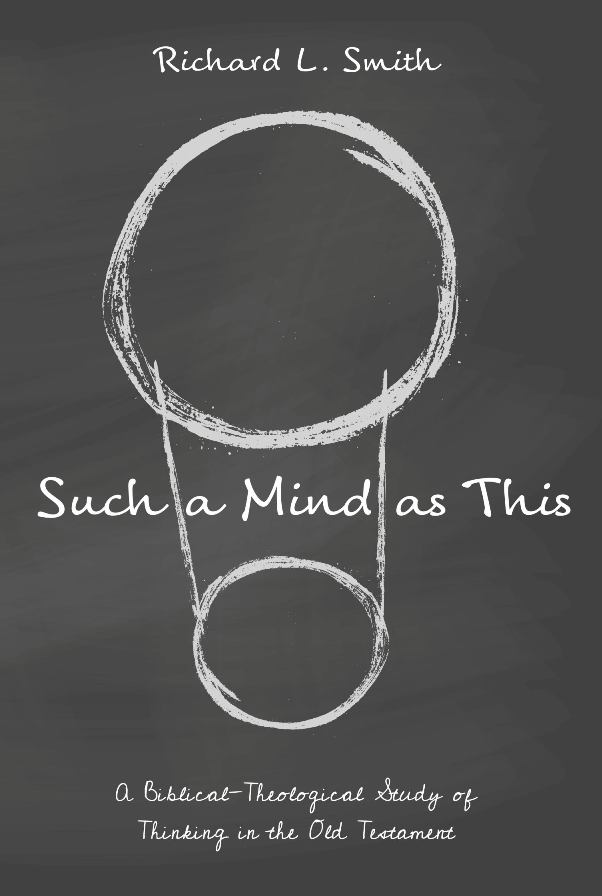
Such a Mind as This: A Biblical-Theological Study of Thinking in the Old Testament, Richard L. Smith. Eugene: Wipf & Stock, 2021. Softcover, 418 pages.
If words such as ‘epistemology’ and ‘ontology’ excite, rather than intimidate you, this book is for you. In other words, readers will need to have a bit of a philosophical bent to appreciate this study of thinking in the Old Testament. Personally, I really enjoyed the author’s depth of insight into God’s Word.
Richard Smith has his Ph.D. from Westminster Theological Seminary. Westminster, of course, was the place where Cornelius Van Til (1895-1987) taught for many years, and an institution that continues his legacy of presuppositional apologetics. Hence it’s no surprise that Van Til’s name appears in the acknowledgements, one of his famous diagrams on the front cover, and his perspective within the covers.
Van Til was often criticized for not providing enough exegetical foundation for his views. Over the years, many of his acolytes have remedied this. However, this book is a deeper dive specifically into the biblical foundations of Reformed epistemology. It complements and enhances everything expressed by Van Til and those who’ve followed in his steps.
The author tells us that “This book was written for Christians who want to develop their minds in a distinctly Christian fashion and grow in discernment” (p.xxi). Further, he writes, “By comprehensively examining Old Testament teaching concerning the mind, this book promotes a spirituality that puts thinking in its proper place” (p.xxiii). Such a Mind as This encourages thinking that acknowledges God in every way and in every circumstance.
It does this by organizing what the Old Testament says about thinking in terms of four categories or orientations. Edenic epistemology has to do with mindset of Adam and Eve before the fall. Exilic epistemology captures the thinking of Adam and Eve and their posterity after the fall into sin and their exile from Eden. Punitive epistemology is the label Smith gives to “divinely imposed obduracy” (p.168). Last of all, redemptive epistemology describes the mindset of the regenerated Christian, a mindset that God graciously provides and one of which he approves.
Different passages and books of the Bible are exposited under the heading of those four categories. For example, Smith reads Job “through the prism of redemptive epistemology” (p.290). Ecclesiastes, on the other hand, is representative of exilic epistemology. He concludes about that book, “… Qohelet demonstrates the profound complexity of unbelieving thought, as well as its necessarily contradictory nature” (p.118).
This book isn’t for everybody. But if you’re interested in apologetics or a Christian perspective on philosophy, I think you’ll enjoy it. It’s well-organized and while the writing is often technical, it’s still artful – his style reminds me of John Murray. There were a few typos and I do question whether Adam might have seen a female gorilla carrying a young one in the Garden of Eden (p.26). Notwithstanding, this book will be my go-to resource for what the OT teaches about the mind. It’s a unique, stimulating, and helpful work
Introduction
The Bible speaks about our political philosophy and politicians as followers of Jesus Christ. Let us consider briefly Moses’ instruction concerning future kings in Deuteronomy 17:14–20.
14 “When you come to the land that the Lord your God is giving you, and you possess it and dwell in it and then say, ‘I will set a king over me, like all the nations that are around me,’ 15 you may indeed set a king over you whom the Lord your God will choose. One from among your brothers you shall set as king over you. You may not put a foreigner over you, who is not your brother. 16 Only he must not acquire many horses for himself or cause the people to return to Egypt in order to acquire many horses, since the Lord has said to you, ‘You shall never return that way again.’ 17 And he shall not acquire many wives for himself, lest his heart turn away, nor shall he acquire for himself excessive silver and gold. 18 “And when he sits on the throne of his kingdom, he shall write for himself in a book a copy of this law, approved by the Levitical priests. 19 And it shall be with him, and he shall read in it all the days of his life, that he may learn to fear the Lord his God by keeping all the words of this law and these statutes, and doing them, 20 that his heart may not be lifted up above his brothers, and that he may not turn aside from the commandment, either to the right hand or to the left, so that he may continue long in his kingdom, he and his children, in Israel.
Keep in mind, this passage does not teach everything that the Bible says about the political sphere, but it is an important starting point. Also, I cannot explain every aspect of this passage; nor can I demonstrate all the implications for political activity in modernity. I provide only a basic framework and important principles to consider.
I recognize, as well, there are differences between Old and New Testament revelation and differences between the Old and New Testament people of God. Ruling an ancient theocracy and leadership in the New Testament church are distinct. There are also significant differences between political leadership in the ancient world and modern governance within a pluralistic society. Still, I believe we can learn very important lessons for our time from this passage.
Ancient Kingship
Ancient kings were selected and favored by their gods. They claimed the divine right to subjugate their nations and to conquer other peoples nearby. Kings functioned as the gods’ image and representative. They served as priests and patrons of worship. Kings functioned as the chief lawgiver and possessed supreme judicial authority. As their nation’s designated warrior, they led their people in battle and protected them from all threats, internal and external. Violence and corruption were often associated with political power. Typically, kings manifested vanity and arrogance, since they were highly motivated by pleasure, greed, and glory.
Calling to Kingship
Israelite kings, on the other hand, were presented with an altogether different vision of leadership. Deuteronomy 17:15 informs the prospective ruler: “You may indeed set a king over you whom the Lord your God will choose. One from among your brothers you shall set as king over you. You may not put a foreigner over you, who is not your brother.” This verse reveals two initial qualifications of rulership. True kings were designated by God. National leadership was a divine calling and not simply a secular profession. The Hebrews could not simply employ a qualified politician of any worldview to provide political leadership. Their leaders arose from within the covenant community and affirmed a covenantal worldview.
Prohibitions of Kingship
Verses 16–17 stipulate: “Only he must not acquire many horses for himself or cause the people to return to Egypt to acquire many horses, since the Lord has said to you, ‘You shall never return that way again.’ And he shall not acquire many wives for himself, lest his heart turn away, nor shall he acquire for himself excessive silver and gold.” These verses express three prohibitions of a Hebrew leader in distinction to the kings of other nations.
The first concerns military power. Horses pulled chariots and provided a significant military advantage. But they required an extensive infrastructure since they were expensive to buy, care for, and train. This prohibition limited the king’s power through proscribing a professional army. The admonition also warned Israel never to return to Egypt, who specialized in chariot warfare. Partnering with Egypt, manifested trust in military might and foreign alliances, rather than confidence in the Lord, who ironically brought them out of Egypt into the promised land.
The second prohibition concerns status. Harems were intrinsically carnal and hedonistic, and contrary to Old Testament norms. In terms of reputation, however, a large harem communicated status and wealth on the international stage. Further, establishing political alliances through multiple marriages demonstrated a lack of confidence in the Lord. The phrase “lest his heart turn away” refers to apostasy, disobedience, and idolatry. King Solomon’s foreign wives skewed his thinking and behavior. Likewise, King David was corrupted by lust and arrogance.
The third prohibition concerns wealth. National rulership provided access to illicit gain. Kings controlled taxation, trade routes, and rent collection. Kingship was a perfect storm of temptations for power and pleasure, resulting in corruption and apostasy. Notice, also, the expression “for himself” appears three times for emphasis. The king was not to use power for self-benefit or self-promotion.
The Demands of Kingship
Consider verses 18–20, “And when he sits on the throne of his kingdom, he shall write for himself in a book a copy of this law, approved by the Levitical priests. And it shall be with him, and he shall read in it all the days of his life, that he may learn to fear the Lord his God by keeping all the words of this law and these statutes, and doing them, that his heart may not be lifted up above his brothers, and that he may not turn aside from the commandment, either to the right hand or to the left, so that he may continue long in his kingdom, he and his children, in Israel.”
This passage contains three demands linked to Scripture, especially the covenantal norms expressed in the book of Deuteronomy. The king was required to copy the Law, have it always nearby, and read it always.
King David (Arent de Gelden, 1645-1727)
The first command is to copy the Law. In contrast to the prohibitions, he must copy the Law “for himself,” for his own well-being. In fact, the king was required to learn and think like a scribe. In the ancient world, at least 90% could not read or afford to acquire sacred writings. Literacy was a very powerful skill. For this reason, scribes were the intellectuals and theologians of that time. This command for the king, therefore, indicates that theological-biblical literacy was essential for Israel’s supreme leader and for rulership. Moreover, copying the Law under the authority of the priests revealed that the king was a disciple of God’s Word. He depended upon revelation, and he submitted to a higher authority. As one scholar said, “The king was the designated reader” of the nation. He had no authority to teach or interpret the Law, and he could not change or add to it. But he could demonstrate its purpose by being its model.
Second, the king’s personal copy of the Law should always be “with him,” always at his disposal as an ever-ready guide and guidepost for his thinking and conduct.
Third, he must “read it all the days of his life.” God’s Law functioned as the king’s intellectual North Star and spiritual GPS. Life-long learning was a critical spiritual discipline. Four reasons were provided. First and foremost, “that he may learn to fear the Lord” through obedience to the covenant (Deut. 5:29; 6:2; 10:12–13). Israel’s pedagogical infrastructure aimed at inculcating the fear of the Lord. In this way, the king displayed the same piety demanded of the people (Deut. 14:23; 17:19; 31:12). The second reason is, “that his heart may not be lifted up above his brothers.” Learning to fear the Lord, counterbalanced royal arrogance. Third, cultivating the fear of God prevented apostasy and idolatry, so “that he may not turn aside.” And lastly, personal piety fostered personal and public prosperity “so that he may continue long in his kingdom” (Deut 4:40; 5:29, 33; 6:3, 18; 12:28).
Implications for Political Spirituality
Political leadership is a divine calling. Electoral novices and spiritual acolytes should carefully count the cost, for this path is fraught with temptations of every kind. Qualified aspirants for public leadership embrace this commission with spiritual oversight and affirmation.
Political leadership requires advanced biblical and theological literacy. Christian politicians reason from and with revelation. They affirm the biblical worldview. They embrace lifelong knowledge acquisition. Self-knowledge and situational discernment are essential competencies. Israel’s kings were commissioned to embody the Shema (Deut 6:4–5) and especially to love God with the mind.
Political service is both counter- and cross-cultural. Public policy arises from social priorities in God’s Word and the common good, more than party affiliation and off-the-shelf political philosophy.
Christian politicians are highly ethical public servants. They understand Proverbs 8:13, “The fear of the Lord is hatred of evil. Pride and arrogance and the way of evil and perverted speech I hate.” For this reason, politicians flee lust of all kinds: status, wealth, and pleasure, as well as sins of manipulation and deception.
Lastly, Christian political spirituality is rooted in the fear of God: “The fear of the Lord is the beginning of knowledge; fools despise wisdom and instruction” (Prov 1:7). Christian politicians avoid intellectual and behavioral folly with all their being. They embrace this truism as way of life, “I am sending you out as sheep in the midst of wolves, so be wise as serpents and innocent as doves” (Matt 10:16).
 want to develop their minds in a distinctly Christian fashion and grow in discernment” (p.xxi). Further, he writes, “By comprehensively examining Old Testament teaching concerning the mind, this book promotes a spirituality that puts thinking in its proper place” (p.xxiii). Such a Mind as This encourages thinking that acknowledges God in every way and in every circumstance.
 Such a Mind as This