New Title from Elmer John Thiessen
Healthy Christian Minds: A Biblical, Practical, and Sometimes Philosophical Exploration of Intellectual Virtues and Vices
“All of us possess opinions (wise and foolish). All have influence (positive and negative). And all of us should communicate with greater Christlikeness. Based on his teaching experience, lifelong learning, and acquired wisdom, Dr. Thiessen’s book teaches intellectual piety. This is an accessible text blending insights
from philosophy, biblical teaching, and cultural critique that are essential in our tribalistic church and society. The final prayer is worth the price of the book.” —Richard L. Smith, director, Kuyper Center for Christian Studies, Buenos Aires.
Moses was a model thinker in ancient Israel. He was supremely knowledgeable and wise. He feared God and modeled intellectual virtue. His theological outlook was expressed in Deuteronomy, the nation’s covenantal masterpiece. His mental piety was articulated in the Psalms. His teaching and character deeply impacted the Old and New Testaments. Jesus and Paul viewed Moses with the highest regard.
Numbers 12 summarizes Moses’ epistemic profile, “Now the man Moses was very meek, more than all people who were on the face of the earth” (v. 3). Moses embodied intellectual humility, even in the face of strident criticism (see vs. 1–2). God said about him, “He is faithful in all my house. With him I speak mouth to mouth, clearly, and not in riddles, and he beholds the form of the Lord” (vs. 7b–8a). Moses reasoned, therefore, from and with revelation. His aligned his motivation, attitude, speech, and conduct with God’s law.
In addition to receiving instruction directly from the Lord, Acts 7:20 provides this description of Moses’ intellectual formation, “Moses was instructed in all the wisdom of the Egyptians, and he was mighty in his words and deeds.” In its battle with foreign influence, Jewish tradition often expressed haliographic and apologetic agendas concerning Moses and his legacy. For instance, Moses taught authentic philosophy and invented alphabetic composition. Egypt taught him music and mathematics. The Greeks instructed him in grammar and astronomy. A scholar described this common belief in antiquity, “Moses acquired from the inhabitants of the neighboring countries a knowledge of Assyrian letters [their worldview], as well as the Chaldean science of heaving bodies [astrology, divination, sorcery, magic].”[i] Legends such as these, however, are improbable.
Guercino, 1618-19
A greater likelihood is that the “wisdom of the Egyptians” entails four mental and social attributes.[ii] First, as a member of the royal court (Exod 2:10), Moses imbibed Egyptian ideology. According to their worldview, Pharaoh was divine, associated with the gods of creation and he was the incarnation of Horus, the nation’s divine protector. As the intermediary between heaven and earth, Pharaohs functioned as high priests. They were worshipped and they provided benefaction in support of the nation’s theocracy. They upheld primeval order and embodied its principles.
Second, Egypt’s kings embraced an imperial mindset. By divine decree, they were charged with subjugating other peoples and creating an empire. Egyptian ideology expressed an “Egyptocentric” mentality affirming their supremacy over all other nations. They viewed other peoples and their religions with upmost disregard and suspicion. Thus, “when Pharaoh asked, ‘Who is the Lord, that I should obey him and let Israel go?’ he asked a very important question . . . In effect, his query was: Who is the true God?” I wrote:
His question also implies several other crucial questions that recur in the Old Testament. Who are the real people of God? In which society might humans flourish? Through whom will the earth be blessed—Cain’s progeny (all god-kings and would-be empires) or the seed of Abraham? Which is the true land of promise, Egypt (another theocracy or utopia) or Canaan?[iii]
Third, Moses was likely well-acquainted with Egyptian spiritual technology: magic, divination, and sorcery (Exod 7:9–12). Likewise, he understood the social-economic status associated with the religious and intellectual elite of the nation. Moses experienced a “social and religious infrastructure” that “was skewed by polytheism, theocracy, and empire.”[iv] The royal court, its powerful wise men, and the retainers who served them, benefited economically from forced servitude of the Hebrews and other enslaved peoples.
Fourth, the curriculum that Moses learned was probably like the indoctrination Daniel encountered as an exile in Babylon (Dan 1:4–7).[v] He learned the language of Babylonia and studied their worldview texts as future scribes and counselors. In this way, he internalized the ideological and spiritual priorities of Babylon. And he was socialized into the lifestyles of the religious and intellectual leaders of society. “Cultural literacy enabled conceptual fluency—the ability to reason from ontological and epistemological presuppositions embedded in the Babylonian worldview.” [vi] Daniel would, then, counsel the king as a wise man of Babylon―not as pious Hebrew from Israel, they hoped.
Finally, Hebrews 11:24–26 summarizes Moses’ mindset when he returned to Egypt as Israel’s leader. He rejected all that the Egyptian worldview represented and provided as a member of the highest class in the nation:
By faith Moses, when he was grown up, refused to be called the son of Pharaoh’s daughter, choosing rather to be mistreated with the people of God than to enjoy the fleeting pleasures of sin. He considered the reproach of Christ greater wealth than the treasures of Egypt, for he was looking to the reward.
The three underlined verbs express intellectual, ethical, and spiritual intent. First, after Moses’ mental outlook matured, he “refused to be called the son of Pharaoh’s daughter.” He repudiated the identity and socialization of Egypt. Second, he chose “to be mistreated with the people of God than to enjoy the fleeting pleasures of sin.” This determination implied theoretical and moral evaluation. Moses deemed Israel and its calling under God of much greater value than the very best that Egypt could offer. Third, from a New Testament perspective, Moses “considered the reproach of Christ greater wealth than the treasures of Egypt, for he was looking to the reward.” By faith, Moses reasoned eschatologically. He anticipated a far greater prophet and savior than himself (Deut 18:15, 18).
Moses, therefore, embodied wisdom and mental piety derived from godly fear (Prov 1:17; 8:13). He modeled the Shema (Deut 6:4–5) and aspired to love God with “all his mind” (Mark 12:30).
For these reasons, Moses serves as a model thinker for the church today. We ought to replicate his mentality. We should “refuse to be called (fill in the blank),” meaning identities and socializations imposed upon us. We should turn from the “fleeting pleasures of sin” that hinder and distract from Christ’s mission. Our thinking must change, if we truly “consider the reproach of Christ greater wealth than the treasures of (fill in the blank).”
Imagine how our spirituality would evolve if we, like Moses, learned to love God with our minds and developed intellectual piety rooted in the fear of the Lord.
[i] Louis H. Feldman, “Philo’s View of Moses Birth and Upbringing,” page 275.
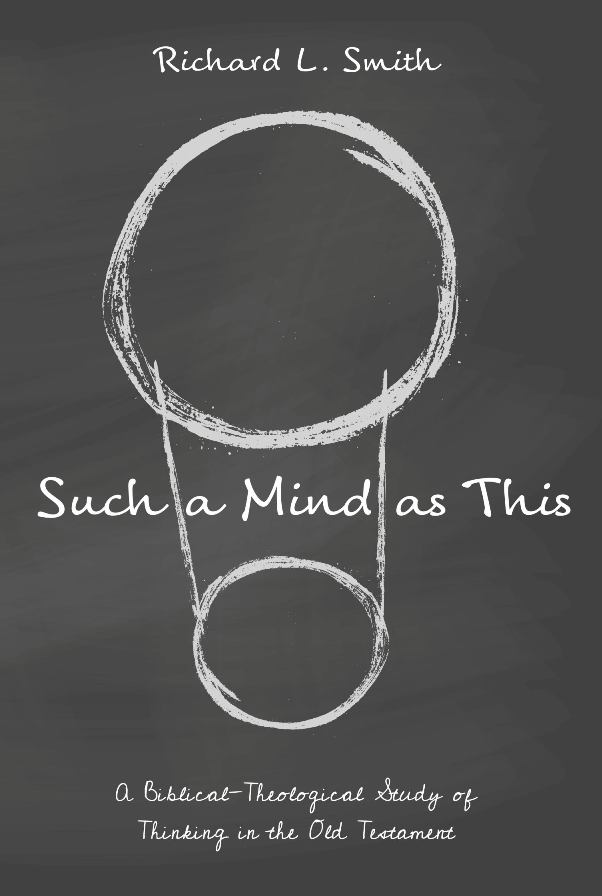
Such a Mind as This: A Biblical-Theological Study of Thinking in the Old Testament, Richard L. Smith. Eugene: Wipf & Stock, 2021. Softcover, 418 pages.
If words such as ‘epistemology’ and ‘ontology’ excite, rather than intimidate you, this book is for you. In other words, readers will need to have a bit of a philosophical bent to appreciate this study of thinking in the Old Testament. Personally, I really enjoyed the author’s depth of insight into God’s Word.
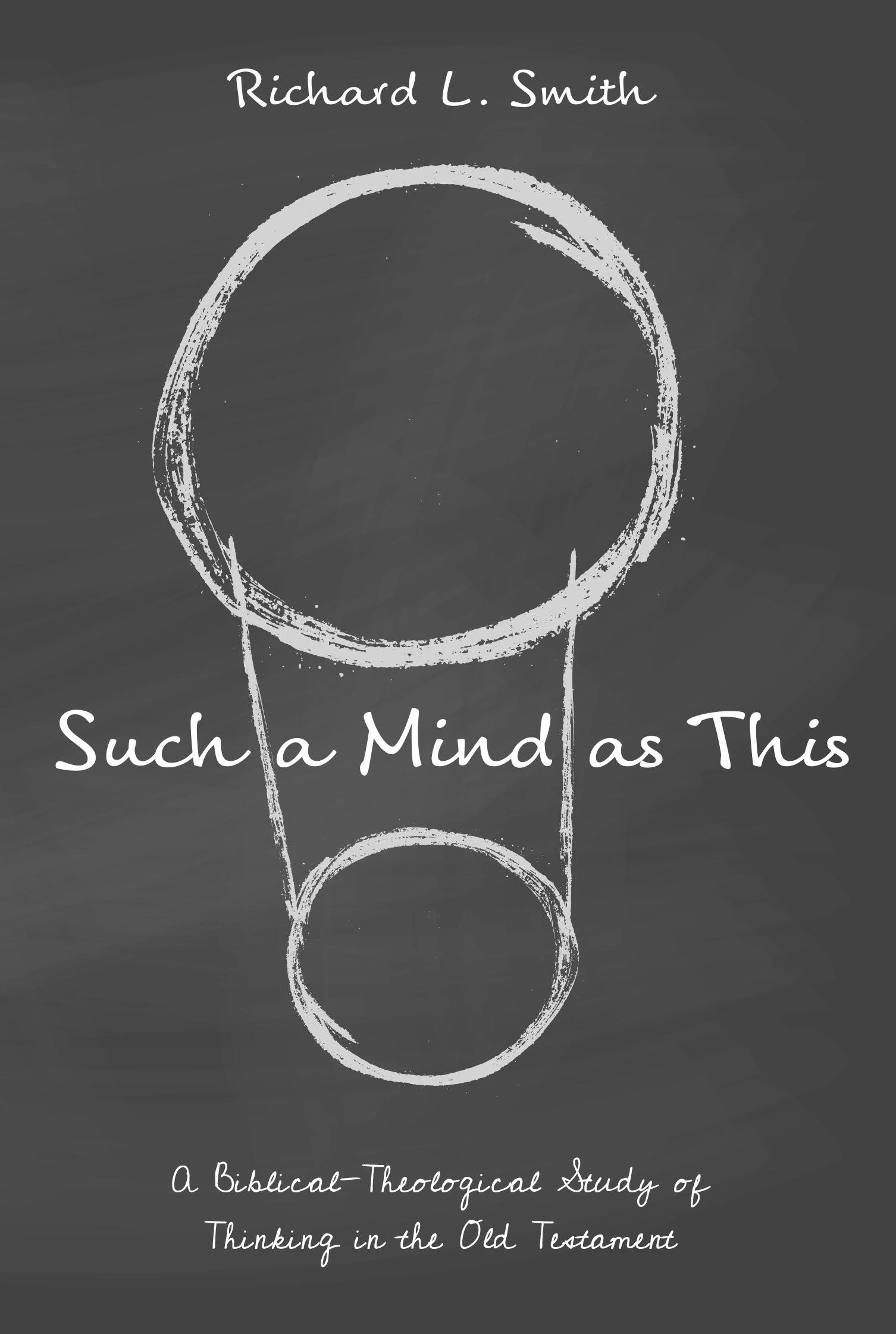
Richard Smith has his Ph.D. from Westminster Theological Seminary. Westminster, of course, was the place where Cornelius Van Til (1895-1987) taught for many years, and an institution that continues his legacy of presuppositional apologetics. Hence it’s no surprise that Van Til’s name appears in the acknowledgements, one of his famous diagrams on the front cover, and his perspective within the covers.
Van Til was often criticized for not providing enough exegetical foundation for his views. Over the years, many of his acolytes have remedied this. However, this book is a deeper dive specifically into the biblical foundations of Reformed epistemology. It complements and enhances everything expressed by Van Til and those who’ve followed in his steps.
The author tells us that “This book was written for Christians who want to develop their minds in a distinctly Christian fashion and grow in discernment” (p.xxi). Further, he writes, “By comprehensively examining Old Testament teaching concerning the mind, this book promotes a spirituality that puts thinking in its proper place” (p.xxiii). Such a Mind as This encourages thinking that acknowledges God in every way and in every circumstance.
It does this by organizing what the Old Testament says about thinking in terms of four categories or orientations. Edenic epistemology has to do with mindset of Adam and Eve before the fall. Exilic epistemology captures the thinking of Adam and Eve and their posterity after the fall into sin and their exile from Eden. Punitive epistemology is the label Smith gives to “divinely imposed obduracy” (p.168). Last of all, redemptive epistemology describes the mindset of the regenerated Christian, a mindset that God graciously provides and one of which he approves.
Different passages and books of the Bible are exposited under the heading of those four categories. For example, Smith reads Job “through the prism of redemptive epistemology” (p.290). Ecclesiastes, on the other hand, is representative of exilic epistemology. He concludes about that book, “… Qohelet demonstrates the profound complexity of unbelieving thought, as well as its necessarily contradictory nature” (p.118).
This book isn’t for everybody. But if you’re interested in apologetics or a Christian perspective on philosophy, I think you’ll enjoy it. It’s well-organized and while the writing is often technical, it’s still artful – his style reminds me of John Murray. There were a few typos and I do question whether Adam might have seen a female gorilla carrying a young one in the Garden of Eden (p.26). Notwithstanding, this book will be my go-to resource for what the OT teaches about the mind. It’s a unique, stimulating, and helpful work
Introduction
The Bible speaks about our political philosophy and politicians as followers of Jesus Christ. Let us consider briefly Moses’ instruction concerning future kings in Deuteronomy 17:14–20.
14 “When you come to the land that the Lord your God is giving you, and you possess it and dwell in it and then say, ‘I will set a king over me, like all the nations that are around me,’ 15 you may indeed set a king over you whom the Lord your God will choose. One from among your brothers you shall set as king over you. You may not put a foreigner over you, who is not your brother. 16 Only he must not acquire many horses for himself or cause the people to return to Egypt in order to acquire many horses, since the Lord has said to you, ‘You shall never return that way again.’ 17 And he shall not acquire many wives for himself, lest his heart turn away, nor shall he acquire for himself excessive silver and gold. 18 “And when he sits on the throne of his kingdom, he shall write for himself in a book a copy of this law, approved by the Levitical priests. 19 And it shall be with him, and he shall read in it all the days of his life, that he may learn to fear the Lord his God by keeping all the words of this law and these statutes, and doing them, 20 that his heart may not be lifted up above his brothers, and that he may not turn aside from the commandment, either to the right hand or to the left, so that he may continue long in his kingdom, he and his children, in Israel.
Keep in mind, this passage does not teach everything that the Bible says about the political sphere, but it is an important starting point. Also, I cannot explain every aspect of this passage; nor can I demonstrate all the implications for political activity in modernity. I provide only a basic framework and important principles to consider.
I recognize, as well, there are differences between Old and New Testament revelation and differences between the Old and New Testament people of God. Ruling an ancient theocracy and leadership in the New Testament church are distinct. There are also significant differences between political leadership in the ancient world and modern governance within a pluralistic society. Still, I believe we can learn very important lessons for our time from this passage.
Ancient Kingship
Ancient kings were selected and favored by their gods. They claimed the divine right to subjugate their nations and to conquer other peoples nearby. Kings functioned as the gods’ image and representative. They served as priests and patrons of worship. Kings functioned as the chief lawgiver and possessed supreme judicial authority. As their nation’s designated warrior, they led their people in battle and protected them from all threats, internal and external. Violence and corruption were often associated with political power. Typically, kings manifested vanity and arrogance, since they were highly motivated by pleasure, greed, and glory.
Calling to Kingship
Israelite kings, on the other hand, were presented with an altogether different vision of leadership. Deuteronomy 17:15 informs the prospective ruler: “You may indeed set a king over you whom the Lord your God will choose. One from among your brothers you shall set as king over you. You may not put a foreigner over you, who is not your brother.” This verse reveals two initial qualifications of rulership. True kings were designated by God. National leadership was a divine calling and not simply a secular profession. The Hebrews could not simply employ a qualified politician of any worldview to provide political leadership. Their leaders arose from within the covenant community and affirmed a covenantal worldview.
Prohibitions of Kingship
Verses 16–17 stipulate: “Only he must not acquire many horses for himself or cause the people to return to Egypt to acquire many horses, since the Lord has said to you, ‘You shall never return that way again.’ And he shall not acquire many wives for himself, lest his heart turn away, nor shall he acquire for himself excessive silver and gold.” These verses express three prohibitions of a Hebrew leader in distinction to the kings of other nations.
The first concerns military power. Horses pulled chariots and provided a significant military advantage. But they required an extensive infrastructure since they were expensive to buy, care for, and train. This prohibition limited the king’s power through proscribing a professional army. The admonition also warned Israel never to return to Egypt, who specialized in chariot warfare. Partnering with Egypt, manifested trust in military might and foreign alliances, rather than confidence in the Lord, who ironically brought them out of Egypt into the promised land.
The second prohibition concerns status. Harems were intrinsically carnal and hedonistic, and contrary to Old Testament norms. In terms of reputation, however, a large harem communicated status and wealth on the international stage. Further, establishing political alliances through multiple marriages demonstrated a lack of confidence in the Lord. The phrase “lest his heart turn away” refers to apostasy, disobedience, and idolatry. King Solomon’s foreign wives skewed his thinking and behavior. Likewise, King David was corrupted by lust and arrogance.
The third prohibition concerns wealth. National rulership provided access to illicit gain. Kings controlled taxation, trade routes, and rent collection. Kingship was a perfect storm of temptations for power and pleasure, resulting in corruption and apostasy. Notice, also, the expression “for himself” appears three times for emphasis. The king was not to use power for self-benefit or self-promotion.
The Demands of Kingship
Consider verses 18–20, “And when he sits on the throne of his kingdom, he shall write for himself in a book a copy of this law, approved by the Levitical priests. And it shall be with him, and he shall read in it all the days of his life, that he may learn to fear the Lord his God by keeping all the words of this law and these statutes, and doing them, that his heart may not be lifted up above his brothers, and that he may not turn aside from the commandment, either to the right hand or to the left, so that he may continue long in his kingdom, he and his children, in Israel.”
This passage contains three demands linked to Scripture, especially the covenantal norms expressed in the book of Deuteronomy. The king was required to copy the Law, have it always nearby, and read it always.
King David (Arent de Gelden, 1645-1727)
The first command is to copy the Law. In contrast to the prohibitions, he must copy the Law “for himself,” for his own well-being. In fact, the king was required to learn and think like a scribe. In the ancient world, at least 90% could not read or afford to acquire sacred writings. Literacy was a very powerful skill. For this reason, scribes were the intellectuals and theologians of that time. This command for the king, therefore, indicates that theological-biblical literacy was essential for Israel’s supreme leader and for rulership. Moreover, copying the Law under the authority of the priests revealed that the king was a disciple of God’s Word. He depended upon revelation, and he submitted to a higher authority. As one scholar said, “The king was the designated reader” of the nation. He had no authority to teach or interpret the Law, and he could not change or add to it. But he could demonstrate its purpose by being its model.
Second, the king’s personal copy of the Law should always be “with him,” always at his disposal as an ever-ready guide and guidepost for his thinking and conduct.
Third, he must “read it all the days of his life.” God’s Law functioned as the king’s intellectual North Star and spiritual GPS. Life-long learning was a critical spiritual discipline. Four reasons were provided. First and foremost, “that he may learn to fear the Lord” through obedience to the covenant (Deut. 5:29; 6:2; 10:12–13). Israel’s pedagogical infrastructure aimed at inculcating the fear of the Lord. In this way, the king displayed the same piety demanded of the people (Deut. 14:23; 17:19; 31:12). The second reason is, “that his heart may not be lifted up above his brothers.” Learning to fear the Lord, counterbalanced royal arrogance. Third, cultivating the fear of God prevented apostasy and idolatry, so “that he may not turn aside.” And lastly, personal piety fostered personal and public prosperity “so that he may continue long in his kingdom” (Deut 4:40; 5:29, 33; 6:3, 18; 12:28).
Implications for Political Spirituality
Political leadership is a divine calling. Electoral novices and spiritual acolytes should carefully count the cost, for this path is fraught with temptations of every kind. Qualified aspirants for public leadership embrace this commission with spiritual oversight and affirmation.
Political leadership requires advanced biblical and theological literacy. Christian politicians reason from and with revelation. They affirm the biblical worldview. They embrace lifelong knowledge acquisition. Self-knowledge and situational discernment are essential competencies. Israel’s kings were commissioned to embody the Shema (Deut 6:4–5) and especially to love God with the mind.
Political service is both counter- and cross-cultural. Public policy arises from social priorities in God’s Word and the common good, more than party affiliation and off-the-shelf political philosophy.
Christian politicians are highly ethical public servants. They understand Proverbs 8:13, “The fear of the Lord is hatred of evil. Pride and arrogance and the way of evil and perverted speech I hate.” For this reason, politicians flee lust of all kinds: status, wealth, and pleasure, as well as sins of manipulation and deception.
Lastly, Christian political spirituality is rooted in the fear of God: “The fear of the Lord is the beginning of knowledge; fools despise wisdom and instruction” (Prov 1:7). Christian politicians avoid intellectual and behavioral folly with all their being. They embrace this truism as way of life, “I am sending you out as sheep in the midst of wolves, so be wise as serpents and innocent as doves” (Matt 10:16).
(The following is a devotional I prepared for the Centro de Estudios Cristianos Kuyper in Buenos Aires concerning social media and intellectual piety.)
Based on what we learned today, social media in particular and AI in general are both powerful tools and a dangerous threat. Social media is a medium and a message that has positive and negative impacts. The technology itself impacts our brains. It demands attention and often produces addiction and obsession. (Keep in mind that we have not discussed computer games or pornography.)
The message is often about consumerism and whatever values popular culture celebrates. Sometimes, it fosters extremism and harmful ideologies. Together, the medium and the message often promote anti-intellectualism, twisted forms of groupthink, and tribalism. It discourages critical reasoning and reading. One author calls social media and the internet a “weapon of mass distraction.” Social media use often distracts us from what is really important.
Social media, therefore, teaches, mentors, and disciples its followers. But the question that we must answer is, who disciples us, as Christian believers?
The church is challenged by social media in at least two ways. First, the minds of unbelievers are captured by harmful values and deceptive mental habits. Second, the minds of many believers are impacted by the same values and practices.
Sadly, most Christians manifest the same social media use as broader society. This messenger communicates constantly with us in forms which seem more compelling than the church and the word of God. In addition, using new and powerful technologies, “the god of this world has blinded the minds of the unbelievers, to keep them from seeing the light of the gospel of the glory of Christ, who is the image of God” (2 Cor 4:4).
For a few minutes, therefore, I will frame the challenges of social media in terms of the biblical worldview.
The first theme is listening. For the Bible, the chief intellectual question is: who are we listening to? Listening correctly is the pathway to knowledge, wisdom, and blessing. Listening incorrectly is the pathway to folly and destruction.
In Genesis 3, when God confronted Adam and Eve, the reason he provided was intellectual. They had listened to the serpent and adopted his worldview. In Deuteronomy 8, God showed mankind the key to knowledge, not just about God but about every fact of creation. He said:
And he humbled you and let you hunger and fed you with manna, which you did not know, nor did your fathers know, that he might make you know that man does not live by bread alone, but man lives by every word that comes from the mouth of the Lord. (v. 3)
God explained that “man,” meaning human beings in general and not only Israel, “live” by listening to the word of God. When we do not listen, we lack comprehension and we do not prosper.
In the New Testament, Jesus used this story from the Old Testament about eating the mana from heaven and called himself the “bread of life.” He said, “For the bread of God is he who comes down from heaven and gives life to the world” (John 6:33). He also told us that, “the words that I have spoken to you are spirit and life” (John 6:63).
In Luke 6, he told us, “Everyone who comes to me and hears my words and does them, I will show you what he is like: he is like a man building a house, who dug deep and laid the foundation on the rock” (vs. 47–48). In a similar passage, he called those who hear and obey “wise servants.”
In Mark 9, God said about Jesus, “This is my beloved Son; listen to him” (v. 7). And Jesus, himself, instructed us, “Take care then how you hear” (Luke 8:18). Healthy Christians and mature believers, therefore, listen to revelation and know how to distinguish between true and false messengers and messages.
The second theme is our intellectual context. In Matthew 24, the disciples asked Jesus about the destruction of Jerusalem and the end of the world. We do not have time to read the passage, but I want to point out several themes the Lord emphasized that have intellectual implications for us.
He warned them about being led “astray,” meaning falling into syncretism, ethical disobedience, embracing false worldviews, and deserting the faith. Five times he mentioned the term “astray” (vs. 4, 5, 10, 11, 24). He told them “do not believe” false messages and messengers (vs. 23, 25). He advised them to become aware (v. 39), to “stay awake” (vs. 42, 43), and become “faithful and wise” servants (v. 45). Self- and situational awareness must be our mental outlook at this moment in God’s redemptive story.
Finally, there are several implications of these two themes for us to consider. Today, every day, we hear thousands of messages through a very powerful and addictive medium. These messengers struggle to capture our attention and disciple our minds and conduct. We do our thinking within this intellectual matrix. Yet, Jesus called us to be “wise as serpents and innocent as doves” (Matt 10:16). How will we resist temptation and the pressure to conform? Who will we pay attention to? Jesus told us to “set our mind on the things of God” and not “on the things of man” (Mark 8:33).
I believe that there is no greater challenge in the church today than learning to listen correctly. There is no greater need in the church today than learning to love God with the mind. Developing mental piety is the pathway to life and spiritual safety. Intellectual holiness will make us better teachers, communicators, and evangelists.
Again, there are no more important questions for us to answer than, who are we listening to? Who will disciple us? Who will teach us how to use our minds?
We must ask ourselves: What changes are we willing to make to become wise stewards of our minds? The process involves an honest self-assessment and repentance. We must identify harmful messages and messengers and turn from them. We must minimize and manage the foolish and trivial input and turn to input that is important and relevant for our Christian life.
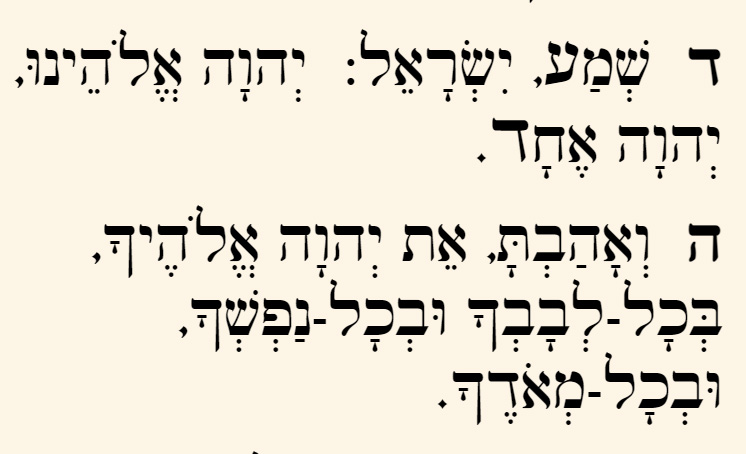
We often talk about wholistic spirituality, a concept expressed in the Shema:
Hear, O Israel: The Lord our God, the Lord is one.You shall love the Lord your God with all your heart and with all your soul and with all your might.
Here we see an indicative statement of theological truth, “The Lord our God, the Lord is one,” followed by an imperative, saying, “[therefore], you shall love the Lord your God with all your heart [mind] and with all your soul and with all your might.”
This passage shows that all of our being must express love and loyalty to God. It teaches that a mind that thinks correctly produces a soul (with its motivations and passions) that desires correctly, which expresses itself concretely in how we live. In the New Testament, Jesus added to the Shema the parallel commandment indicating that true spirituality includes loving our neighbor.
This a why we can also call wholistic spirituality authentic spirituality, because our love flows from who we really are. We express the Shema in all our individual distinctiveness.
So, this is the first purpose of the Shema: to produce authentic individuals who honor God and love others with all of their being.
But there is a second purpose of the Shema. Within its Old Testament context, the Shema is, after all a command, what Jesus called the Greatest Commandment (Mark 12:28-30).
Below are six texts from Deuteronomy, God’s book of law or covenant. You will see several themes demonstrating the purpose of God’s law. Note the vocabulary in bold letters:
Therefore you shall keep his statutes and his commandments, which I command you today, that it may go well with you and with your children after you, and that you may prolong your days in the land that the Lord your God is giving you for all time.” (4:40)
You shall walk in all the way that the Lord your God has commanded you, that you may live, and that it may go well with you, and that you may live long in the land that you shall possess. (5:33)
Hear therefore, O Israel, and be careful to do them, that it may go well with you, and that you may multiply greatly, as the Lord, the God of your fathers, has promised you, in a land flowing with milk and honey. (6:3; the verse that pecedes the Shema)
And you shall do what is right and good in the sight of the Lord, that it may go well with you, and that you may go in and take possession of the good land that the Lord swore to give to your fathers. (6:18; later on after the Shema)
Be careful to obey all these words that I command you, that it may go well with you and with your children after you forever, when you do what is good and right in the sight of the Lord your God. (12:28)
We can see clearly that God’s intention is benevolent. He wants his people to prosper. He wants them to flourish. In terms of John’s gospel, God wants us to experience real “life” by obeying his commandments, especially the Shema.
God desires that our religion be wholistic and authentic, so that we become a blessing in every way. So, we obey the Shema to honor God but also to flourish and serve others.
There is one other verse to consider from Deuteronomy. It is the passage from which I got the title of my book, Such a Mind as This. The context concerns the dramatic theophany on Mount Sinai and the giving of the Ten Commandments (Exodus 19-20). The people felt overwhelmed by God’s majesty and he commented about their outlook:
Oh that they had such a heart [mind] as this always, to fear me and to keep all my commandments, that it might go well with them and with their descendants forever! (Deut 5:29)
This verse shows what it means to love God with the mind according to the Shema: fearing God and obeying his commandments. It also shows that fear and obedience produce goodness and prosperity―that it “might go well” for us.
When we obey the Shema, therefore, we position ourselves to thrive and flourish. This is, at least in part, its purpose and a reason why we learn to love God intellectually.
Nine years ago I produced a short video called Where is God? The original idea arose for a mission trip to Holland in 1991. To communicate the plausibility of the biblical worldview and provide a context for Jesus Christ, I used a white board, diagrams, and word pictures. (Those who know the work of Cornelius Van Til will recongize his famous two circles diagram.)
When Jesus was asked about the greatest commandment, he cited the famous Shema from the Old Testament: “Hear, O Israel: The Lord our God, the Lord is one. You shall love the Lord your God with all your heart and with all your soul and with all your might” (Deut 6:4–5). In Mark, Jesus said: “The most important is, ‘Hear, O Israel: The Lord our God, the Lord is one. And you shall love the Lord your God with all your heart and with all your soul and with all your mind and with all your strength.’The second is this: ‘You shall love your neighbor as yourself.’ There is no other commandment greater than these.” (12:29–31). Luke’s rendition is simpler: “You shall love the Lord your God with all your heart and with all your soul and with all your strength and with all your mind, and your neighbor as yourself” (10:27).
In Jesus’ day, piety that embraced the heart, mind, soul, strength, as well as love for others was the pinnacle of holistic spirituality. This religiosity manifested in three overlapping dimensions: mind, soul, and resources. The mind (“heart” in Hebrew) entailed the intellect (knowledge, curiosity, learning, imagination). The soul referred to our deepest motives (true desires and aspirations). Strength implied an economic dimension: using every kind of human capacity and asset for the glory of God and human wellbeing. Holistic devotion, therefore, required both honor for God and service to human beings.
Mary of Bethany modeled this kind of holistic spirituality. In terms of intellectuality, she was an avid student of Jesus, for she “sat at the Lord’s feet and listened to his teaching” (Luke 10:39). For this reason, he honored her in a very singular manner, saying, “one thing is necessary [learning from and listening to the Lord]. Mary has chosen the good portion, which will not be taken away from her” (v. 42).
Mary was a disciple. She paid attention. She perceived something essential about the Lord. Mary understood who he was and that he would die for her sin. This revelation transformed her mind, renewed her desires, and inspired adoration.
Johannes Vermeer (c. 1655)
With respect to her soul (her innermost values and goals), Mary chose “the good portion.” Her most profound hopes and concerns were aligned with the Lord’s agenda. She was not distracted or blissfully naive.
In terms of love for others, Mary welcomed Jesus and his disciples to her home. She provided hospitality. She fed and cared for them as traveling missionaries (Luke 10:30).
Mary modeled the Shema. She demonstrated her understanding and true priorities with an extraordinary economic deed with respect to the Lord. John recounts the story:
Six days before the Passover, Jesus therefore came to Bethany, where Lazarus was, whom Jesus had raised from the dead.So they gave a dinner for him there. Martha served, and Lazarus was one of those reclining with him at table. Mary therefore took a pound of expensive ointment made from pure nard, and anointed the feet of Jesus and wiped his feet with her hair. The house was filled with the fragrance of the perfume. But Judas Iscariot, one of his disciples (he who was about to betray him), said, “Why was this ointment not sold for three hundred denarii and given to the poor?” He said this, not because he cared about the poor, but because he was a thief, and having charge of the moneybag he used to help himself to what was put into it. Jesus said, “Leave her alone, so that she may keep it for the day of my burial. (12:1–8)
Mark’s account adds Jesus’ testimony about Mary: “She has done a beautiful thing to me . . . She has done what she could; she has anointed my body beforehand for burial” (14:6b–9).
Mary loved God with “all her mind.” She learned and gained discernment. She loved God “with all her soul,” for her paramount desire was to honor and serve Jesus. And because of this, she dedicated “all her strength,” her most precious resource, to express profound love for Jesus. Her spirituality was truly holistic. No aspect of her being was excluded.
Clearly, we should imitate her example. We should love God with our mind, soul, and strength, and love others with all our being as an expression of our devotion to Jesus Christ.
When I was missionary in Prague (1995–2003), I discovered an unusual passage in Luke that impacted my concept of a missionary. The story about a centurion who had “such faith” that Jesus “marveled” (7:1–10) provoked much reflection about missions. It continues to do so now as I serve in Argentina. Let us read the text:
1After he had finished all his sayings in the hearing of the people, he entered Capernaum. 2 Now a centurion had a servant who was sick and at the point of death, who was highly valued by him. 3 When the centurion heard about Jesus, he sent to him elders of the Jews, asking him to come and heal his servant. 4 And when they came to Jesus, they pleaded with him earnestly, saying, “He is worthy to have you do this for him, 5 for he loves our nation, and he is the one who built us our synagogue.” 6 And Jesus went with them. When he was not far from the house, the centurion sent friends, saying to him, “Lord, do not trouble yourself, for I am not worthy to have you come under my roof. 7 Therefore I did not presume to come to you. But say the word, and let my servant be healed. 8 For I too am a man set under authority, with soldiers under me: and I say to one, ‘Go,’ and he goes; and to another, ‘Come,’ and he comes; and to my servant, ‘Do this,’ and he does it.” 9 When Jesus heard these things, he marveled at him, and turning to the crowd that followed him, said, “I tell you, not even in Israel have I found such faith.” 10 And when those who had been sent returned to the house, they found the servant well.
Below I describe the social context, offer an overview of the passage, suggest some implications, and provide an application.
The Context
Israel suffered under foreign domination for more than 600 hundred years. They experienced the rigors of pagan empire and colonization. First, were the Assyrians, then the Babylonians, Greeks, and finally the Romans. One author wrote, “Gentiles were godless, idolatrous, unclean, and rejected by God. Dealings with them made Jews unclean.” Within Luke’s corpus, the Gentiles are portrayed in a very negative manner (Luke 21:24), with reference to their historic separation (Acts 10:28 and 11:3), but finally their inclusion in the global mission of God (22:21–22). Within Luke’s writings, the story of the pious centurion in Luke 7 prefigures outreach to the pagan world. (The following two paragraphs are adapted from my blog, “The Dark Side of Christmas.”)
Closer to the time and place of Jesus’s ministry, Jewish protests of pagan domination were put down by the Romans with sporadic violence. The second major Roman conquest, for instance, came in response to widespread popular insurrections in every major section of Palestine at the death of Herod the Great in 4 A.D. This was right around the time Jesus was born. Also at that time, 6,000 Pharisees refused to take the oath of allegiance to Caesar. That number no doubt grew in the thirty years until Jesus’ ministry.
Shortly before Jesus was born, an incident occurred only four miles from his hometown, Nazareth, in the regional city, Sepphoris. Several movements of peasants led by “messiahs” asserted their local independence in Israel. As a result, the Romans brought ruin and servitude in places connected with Jesus and his followers. For example, an author noted that the Romans “captured and burned the city of Sepphoris and reduced its inhabitants to slavery . . . The whole district became a scene of fire and blood . . . [They] rounded up rebels from around the countryside and crucified about 2,000.”
For these reasons, the profile of a centurion, who represented the Roman empire, was quite negative. Centurions were often violent and corrupt. They represented Caesar and the imperial cult and served as priests. They oversaw the collection of taxes from the Jews and supervised Jewish collaborators.
One wonders, therefore, how this centurion in Luke’s account overcame his negative, cultural heritage and the animosity of the Jews. One commentator observed, “One could claim that this centurion is acting as a shrewd military leader by using civic [benefaction or patronage] to generate reciprocity and facilitate good relations with local Jewish leadership for utilitarian reasons.” But is this how Luke describes the interaction? No.
The Passage
Luke 7:1–10 is a highly unusual story. Unlike the rest of Luke’s gospel, Jesus is cast in an almost a passive role, left to observe and respond. The centurion assumes the initiative and functions as the central character. He starts a process causing Jesus to come to him―two times he sent messages to Jesus (vs. 3 and 6). In contrast to other incidents in the gospel, it was Jesus who was amazed. And most astounding, his assessment of the centurion was extremely positive, even paradigmatic (prefiguring Gentile faith). Jesus discerned the foreigner’s integrity, understanding, and belief. Amazingly, he declared to the watching Jews, “I tell you, not even in Israel have I found such faith (v. 9).” Jesus blessed a normally feared and hated pagan, a representative of Roman ideology producing oppression and injustice in Israel.
The centurion’s positive character also played a prominent role in this story. He manifested compassion and affection for someone subservient to himself, his servant who was “highly valued” (v. 2). He was generous with his wealth (v. 5). He demonstrated respect and
Jesus & the Centurion of Capernaum (c. 1580)
“love” for the Hebrew people, a nation demonized by Roman imperialism (v. 5). He was also humble and open, not ashamed to seek help from a foreign miracle worker (v. 3).
Perhaps most importantly, the centurion perceived in Jesus something special. Presumably, based on what he heard and observed in Jesus’s ministry, he was able to “connect the dots” and correctly intuit Jesus’s significance. Because he understood how true authority operates, he inferred that Jesus also possessed power and agency. Perhaps he recognized that Jesus was not an autonomous agent. He, too, operated under authority.
Another lesson derived from the centurion’s example―and supremely ironic as well―was that he embodied Israel’s ancient creed, the Shema (Deut 6:4–5). He demonstrably loved God with his understanding (“heart” or mind), his deepest desires and motivations (“soul”), and with his resources (“strength” or wealth). In this sense, the foreigner was a paradigmatic Jew.
Implications
This individual managed to overcome a very negative bias as a representative of Rome. He acquired respect, trust, and affection from leaders of a conquered nation. How?
I suggest two ways. First, he embodied a holistic spirituality based upon the Shema, which Jesus himself affirmed (Matt 22:36–38; Mark 12:28–33; Luke 10:25–28). In this manner, the centurion embraced the commandment “most important of all” (Mark 12:28) and learned “how to inherit eternal life” (Luke 10:25). Second, this spiritual posture predisposed him to “love” the Jewish people and construct their synagogue (v. 5). He was the antitype of the typical imperial attitude and behavior. Instead of tearing down, terrorizing, and exploiting, he exhibited respect and support. He built their infrastructure and invested in their deepest needs, for he understood their essential identity.
In all these ways, the centurion of Luke 7 serves as an exemplar of missionary spirituality, motivation, and behavior.
Personal Application
Back in 2002, I wrote about my experience as a missionary from North America in Prague (“A Testimony for Missions”). I close with two paragraphs adapted from that article.
The reality of anti-North American and anti-Western sentiment forces us to consider the perceptions and expectations we have of one another. What biases must be overcome? How can we love nations and peoples? How can we glorify Christ through missions in this age of civilizational conflict, when words and ideas are deconstructed as power plays and imperialistic agendas?
For this reason, western missionaries ought to exegete their cultures. What ‘baggage’ do we carry? How do we view the strengths and weaknesses of our nations? Does our patriotism or our political views or our attitudes towards money affect our values about theology, the Bible, or missions? How do western cultural myths and symbols affect our thinking and behavior? How does the Bible critique our cultures?”
 “All of us possess opinions (wise and foolish). All have influence (positive and negative). And all of us should communicate with greater Christlikeness. Based on his teaching experience, lifelong learning, and acquired wisdom, Dr. Thiessen’s book teaches intellectual piety. This is an accessible text blending insights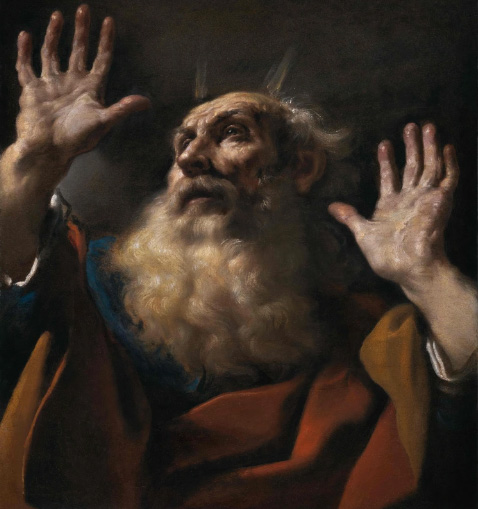




 Such a Mind as This