The Mind Is Important! – Dr. Keith Campbell

Watch these two excerpts from a sermon delivered in Buenos Aires several years ago (with Spanish translation) by Dr. Keith Campbell, Vice-President of Global Scholars and a Founder of the Society of Christian Scholars. Part one concerns the significance of the mind (8:20)  and part two addresses the strategic necessity to reach out to the intelligencia (6:38).

WORLDVIEW FORMATION IS VERY COMPLICATED!

Worldviews are a very complex phenomenon. A worldview is really a web: the convergence of ideas, culture, and history. Our worldview webs are the social and mental matrix in which “we live, and move and have our being,” as Paul says (Acts 17:28).

People are not simply “blank slates” that we write upon with the biblical worldview. They present themselves already locked in a maze of preconceptions and cultural expectations. Those with whom we engage are not simply “empty” or “neutral,” just waiting for us to enlighten them. No. They perceive the world and themselves with sinful biases and idolatries. People are formed by ideas and cultural norms that skew how they view reality, the Bible―and us.

Moreover, worldview formation is difficult to understand because it involves a mix of complex, theological factors. First, there is our post-fall spiritual context: sin complicates everything. Paul mentions in Ephesians 2:1–3 three negative dimensions of human existence: our sinful nature, the world, and the devil.

And you were dead in the trespasses and sins in which you once walked, following the course of this world, following the prince of the power of the air, the spirit that is now at work in the sons of disobedience—among whom we all once lived in the passions of our flesh, carrying out the desires of  the body and the mind, and were by nature children of wrath, like the rest of mankind.

Together, these produce evil “desires of the body and mind.” Paul says in Galatians 1:4 that we live in “this present evil age.”

Second, there is God’s common grace (Ps 104, Acts 14:17), which often restrains evil for his purposes, and amplifies the beauty and potential of this world, even though it is fallen into sin.

Third, there is the gospel itself, which has the power to transform lives and communities.

But fourth, there is the enigmatic concept of divine providence. Consider Acts 17:26–27.

And he made from one man every nation of mankind to live on all the face of the earth, having determined allotted periods and the boundaries of their dwelling place, that they should seek God, and perhaps feel their way toward him and find him. Yet he is actually not far from each one of us.

What does verse 26 mean considering the history and cultures of South America, for example, since God “determined allotted periods and the boundaries of their dwelling place, that they should seek God”? Remember that South America was colonized by Catholic empires. Imagine, however, if the continent had been colonized by Protestant nations. Imagine, also, what might have happened if there had been a Protestant Reformation here. Think about the social, political, economic, and intellectual implications that might have occurred.

Sadly, what really did happen is that millions of people in this continent died, through violence and disease, because of the lust for empire and its cousin, colonialism. Lands were acquired. Peoples were dispersed or enslaved for purposes of security, gain or glory. Millions of Africans were brought as slaves to Brazil.

And Christianity? It was often affiliated with the powerful and prosperous, with empire and colonialism, and overlooked the victims: the poor, exploited, enslaved, abused, and condemned.

We could name other enigmas of history and continue speculating. The matrix of evil, common grace, gospel, and divine providence in human history and worldview formation is very complicated.

We need a lot of humility, wisdom, and compassion to discern the intricate worldview web we encounter in cultures through evangelism, church planting, and missions.

Why? Because people are pre-packaged by ideas and cultural norms in complex ways that distort their worldviews before we arrive. We cannot simply overlay the Bible, assuming that people are open or neutral. They are often wounded, confused, indifferent or hostile.

TAKE OFF YOUR GLASSES, PLEASE!

If you wear reading glasses and look at objects far away or, if you wear glasses for driving and look at objects close at hand, they will appear out of focus, distorted. When I wear my reading glasses, people faraway look strange. Why? Because my glasses distort my vision, how I see reality.

If we think of glasses in a metaphorical way, I suggest that everyone wears glasses. Because everyone looks at the world through distorted lenses and fails to see what is really there―or what God sees. They do not perceive reality or see the truth. They do not see creation or the Creator. This is due to sin.

These distortions happen because our epistemological glasses, so to speak, function as sinful biases, worldviews, and idolatries. The Bible says that human beings have a severe vision problem. Sin affects how and what we see or how and what we think, commonly called the noetic effect of sin.  For this reason, we do not want to see clearly (John 3:19–20).

The Bible teaches, therefore, that we need radical surgery to fix our sight and thinking. For those who follow Christ, this is already happening. Slowly, our vision is being restored and one day in eternity we will see everything clearly, including ourselves (1 Cor 13:12). Until that time, God provides corrective lenses, so to speak, to help us see and think more clearly. The scriptures, under the guidance of the Holy Spirit, provide the God-sanctioned assumptions by which to view the world and operate in it (Ps 16:11; 119:105).

By way of example, think about how people view the Bible. When you look at the information and the worldview represented there as a follower of Jesus, you already possess corrective lenses. You are inclined to look favorably on the Bible and to value its teaching. You see its beauty. You hear the voice of God in the word. You are learning the truth. You are beginning to perceive reality. You understand the Bible’s relevance for yourself and society.

But imagine how an unbeliever views the Bible. They view the same information, but with their sinful biases, presuppositions, and erroneous worldviews. They cannot see what you see. They do not hear God speaking in the text.

Therefore, when we present the Lord Jesus to unbelievers, we must not forget how sinful bias affects spiritual vision. If we talk about the Bible’s relevancy for society or as a revelation from God for our souls, we must always recognize the influence of sin upon our minds. Or, when we focus on the biblical worldview as a framework for interpreting human experience, we cannot forget the intellectual impact of the fall. Of course, we hope and pray that the Spirit works through the text to open eyes and heal sight.

So, when we read the Bible, we should―also―remove our “glasses.” And, when we share the Bible with non-believers, we should say to them, “Take of your glasses, please.”

The Battle for the Imagination – Interview with Dr. Ted Turnau

Ted is the author of two new books: Oasis of Imagination: Engaging our World through a Better Creativity and Imagination Manifesto: A Call to Plant Oases of Imagination.
This video is an interview about his books and ministry.


INTELLECTUAL INERTIA

Inertia is “a tendency to do nothing or to remain unchanged” or “a lack of activity especially when movement is needed.” Intellectual inertia is mental laziness and anti-intellectualism.

The Bible commands Christians to honor God “with all of our mind” (Mark 12:30). I suggest, however, that a profound inertia hinders many evangelicals from obeying this demand. Mental activity is desperately needed, but many Christians are unable or unwilling to embrace intellectual discipleship or to integrate faith and ideas according to the biblical worldview.

The inevitable result is the status quo, marginalization of the church, aversion to risk and entrepreneurialism, and worst of all, the restriction of evangelical Christianity to private emotionalism and cultural irrelevance. Where I live, the evangelical church has little impact upon the educated or elite, the university community, and the cultural gatekeepers. Many believers have ceded worldview dominion, popular culture, and public policy to secular power brokers.

Sadly, our intellectual sluggishness affects every aspect of Christian life and practice. It is “deliberate ignorance,” according to the theologian, John Frame. Why? Because the hegemony of the secular worldview fosters an anti-intellectual outlook that severely restricts faith and practice to the private, subjective, and behavioral realms. As a result, the biblical worldview is neither intellectually plausible nor existentially credible. And of course, God is not honored with our minds and his glory is not displayed in our ideas and practice. Evangelical Christians are complicit and culpable in this dilemma.

When we retreat from the world of ideas, theoretical analysis or cultural critique, how can we discern, for example, the relationship between faith and philosophy, conflicting truth claims and alternative worldviews, faith and science, political ideology and social advocacy, psychology and counseling, business and economics, education, the arts, and so forth?

In contrast, Frame declares that Christians have a God-given “stewardship of the mind and intellect.” He wrote:

It is remarkable that Christians so readily identify the lordship of Christ in matters of worship, salvation, and ethics, but not in thinking. But . . . God in Scripture over and over demands obedience of his people in matters of wisdom, thinking, knowledge, understanding, and so forth. (“A History of Western Philosophy and Theology,” p. 5)

Perhaps then, we should ask a few honest questions that promote intellectual self-awareness:

Are we personally afflicted with self-imposed intellectual inertia?

Is there inertia that hinders the gospel and limits the evangelical church, particularly in your culture?

What does it mean to “love God with all the mind” in your society, especially among cultural gatekeepers, such as the educated and elite classes?


What Do We Sing In Church?

I have been a Christian for more than fifty years. During this time, I have sung many of the same songs―over and over again. The choruses, especially, are problematic―and repetitive, so repetitive. Quite honestly, it is now boring.

It is boring, because our songs are often simply expressions of emotion: how we feel or what we experience. So often, the music is all about “me”: my needs, my emotions, my benefits in Christ.

(Watch this brief satire about “me worship,” using popular choruses with lyrics altered to highlight the “me focus”: “It’s All About Me.”)

It is boring, because so often the musical style is the same―light rock and pop music genres. Is it possible, however, to worship God with other musical genres: folk, classical, or jazz, for example?

It is boring, because many songs concern the experience of conversion, so they are too simple or shallow for mature believers. Could there be hymns about suffering, sanctification, or the perplexities of life or the demands of the gospel or our future in eternity?

It is boring, because there is so little doctrine or intellectual content. Could there be songs that echo the themes of the psalms or prayers of Paul or the deeper doctrines of the Bible? Could we rediscover some of the ancient and classic hymns of the church?

R. C. Sproul commented about contemporary worship, “We have passion―indeed hearts on fire for the things of God. But that passion must resist with intensity the anti-intellectual spirit of the world.” Similarly, Ethan Renow in his article, “The Tragedy of Dumbing-Down Christianity,” summarizes the issue quite well:

We are happy to float along the surface with a “Hillsong-deep theology” and call it  good. And we wonder why people are leaving the Church in droves. A church that offers  only emotional, feel-good theology is going to lose the long-term wrestling match to a   well-read and convincing atheist nearly every time.

As a learning adventure, I urge you to review the table of contents of any classic hymnal, especially a Calvinist hymnbook. You will discover from the themes listed that our music had once been much deeper and broader―and beautiful.

For this reason, I thank God for the music ministries of Keith and Kristyn Getty and Sovereign Grace Music!

“We don’t need theology!” (Really?!)

I recently heard about a conversation between a father and his son concerning theology. The son is a university student. He struggles with the non-Christian worldviews taught at the university. He told his father that he studies theology for answers. He said that an intellectual pursuit of God is an important part of serving God. In response, the father cited 1 Corinthians 8:1, where Paul writes that “knowledge puffs up” while “love builds up.” In effect, he counseled, “Son, we don’t need theology.”

This kind of bias against theology―and anti-intellectualism generally―sometimes appears among evangelicals, particularly among fundamentalists, charismatics, and Pentecostals. The assumption seems to be:

Too much thinking is dangerous.
Too much thinking about God is especially dangerous.
Studying theology is thinking about God too much.
Therefore, theology is dangerous and should be avoided. (It is boring too!)

I attended a charismatic church for many years that embraced this bias. True spirituality was expressed in the realm of feelings, subjectivity, and experience. Pastors who had less theological training were held in high regard. I never adapted to this setting, for I was always curious, always reading, and I even studied religion at a secular university! I was suspected as a source of harmful ideas.

Second, it is also important to define theology. Theology is simply the study of God’s revelation, derived from the Greek terms, theos, “God” and logos, (-ologyor “word”). Theology means “words about God,” “the study of God,” or even “sound doctrine.” In this light, it is insightful to consider Paul’s command for thought leaders (pastors and teachers) in Titus 1:9, “He must hold firm to the trustworthy word as taught, so that he may be able to give instruction in sound doctrine [theology] and also to rebuke those who contradict it.”

Third, it is extremely naive to minimize theology in the Christian life. The historical fact is that we stand upon the shoulders of theological giants, who formulated our precious statements of belief, like the Apostles Creed, Nicene Creed, or Westminster Confession of Faith. Whenever we speak of the Trinity, atonement, sovereignty, or Jesus Christ, for instance, we talk theology. We cannot avoid it. Remember, as well, that the great leaders of the church in the past were often well-trained, such as Augustine, Anselm, Calvin, Wesley, Abraham Kuyper, and C. S. Lewis. Tim Keller, who recently passed away, was an intellectual, theologian, and pastor. Many Christian leaders founded universities, led nations, and served as respected Christian spokesmen.

Finally, an undue fear or avoidance of theology is naive because it fails to recognize that ideas have consequences. I think one of clearest expressions of this reality is the statement of J. Gresham Machen, founder of Westminster Theological Seminary in 1921:

False ideas are the greatest obstacles to the reception of the Gospel. We may preach with all the fervor of a reformer and yet succeed in winning a straggler here and there, if we permit the whole collective thought of the nation or of the world to be controlled by ideas which, by the resistless force of logic, prevent Christianity from being regarded as anything more than a harmless delusion.  Under such circumstances, what God desires us to do is to destroy the obstacle at its root….What is today a matter of academicspeculation begins to move tomorrow armies and pull down empires. In that second stage, it has gone too far to be combated; the time to stop it was when it was still a matter of impassioned debate. So as Christians we should try to mould the thought of the world in such a way as to make the acceptance of Christianity something more than a logical absurdity.

 So, do we need theology? Yes!

Do theological ideas have consequences? Yes!

Should Christians understand what they believe? Yes!


The Heart’s Back Door – Guest Blog

The Heart’s Back Door: Brief Reflections on Worldview Apologetics, Imagination, and Cultural Engagement
Dr. Ted Turnau

The blog is mostly about worldview apologetics, which means essentially, how to get into the web of idols and false beliefs of a non-Christian, and deconstruct it, that is, blow it up from the inside, so that the non-Christian will be open to see the truth of the gospel. It is a very powerful intellectual challenge to unbelief.

But it has its limits. For one thing, it depends on having a non-Christian friend who can reason semi-cogently. Just as the most beautiful painting will not impress a blind man, so the most erudite and elegant reasoning will make no impact on those who just don’t get it. I notice this more and more among my students (I teach cultural and religious studies at a Czech university). They are much more likely to respond to style, feel, image, passion. They are not stupid. On the contrary, many are very, very intelligent. It’s just that they are not attuned to rational debate. They tend to think with their hearts rather than their heads. And a head-first approach often leaves them feeling threatened and defensive. It can become a dead end.

I think the same may be true of the peoples of Latin America. They are famous for their passion, joie de vivre, their intensity. I imagine that trying an intellectual approach can be a dead-end for many of them (especially in countries where “reasonable sounding” people have caused much harm and heartache in the past). That’s why I advocate turning to cultural engagement as an alternative to the standard worldview apologetic. It may be that culture, even popular culture, may be a more fertile field than simply rational argumentation alone. Appealing to the heart through imaginative cultural works may open doors that appealing to the head will not.

There is plenty of culture to engage in Latin America. Each of these countries has a rich cultural heritage, a rich tapestry of imaginative works that just beckons the worldview apologist. Just looking at Argentina alone [where Richard Smith lives], it can boast:

  • amazing storytellers like Cortázar and Borges (the Argentineans who gave the world magical realism),
  • a treasury of visual arts (including some influential graphic arts and work in comics),
  • a thriving film industry (I’ve only seen Man Facing Southeast, Motorcycle Diaries, and Historias Minimas, but now I want to see La Historia Oficial and El Secreto de sus Ojos, too),
  • television shows that extend far beyond telenovela territory into police procedurals (Hermanos y detectives, Epitafios), romantic comedy (Ciega a citas), adventure (Terra Ribelle), darker dramas (Entre caníbales), and even incorporating elements of magical realism (El hipnotizador),
  • and a music scene that extends way beyond the tango into rock nacionale and folk giants including Atahualpa Yupanqui and Mercedes Sosa, whose nueva canción shaped Latin American folk music as a whole.[1]

These cultural works are carriers of worldview, but they work very differently from rational debate. They do not appeal primarily to the intellect (though many are intellectually intriguing). Rather, they appeal to the imagination, and through the imagination, to the heart. When these works are done well, they touch us and cause us to empathize, to feel and see the world from a different perspective. And the results can transform a person, and a nation.

Because these works are so powerful, and sometimes explore territories such as sexuality, crime, vengeance, and rebellion, Christians often draw back and cut themselves off from them. I believe this is a mistake. While we must be careful not to violate our conscience before God, we also must be careful not to isolate ourselves from the imaginative flow of our cultures. This is, after all, where non-Christians live and breathe and have their being. If we wish to understand those we are to love and share God’s love with, we must be willing to engage the culture. We must engage critically, from a biblical worldview perspective, to be sure. But we must also engage appreciatively, looking for what is good, what draws our hearts in, what resonates with truth and grace (it is there, if you’re willing to look for it). And be watching, listening, reading, and willing to talk about these things with non-Christian friends.[2] In short, consider popular culture a sort of mission field for engaging with the imagination of those who share your culture. So the question, then, is: Are Christians in your culture doing this well? If not, what can you do to help? What’s the next step?

Another question worth asking here is: Are Christians actually engaged not just critically, but also creatively? Are Christians in your country making the sorts of cultural works that would draw non-Christians in? Generally, Evangelicals have a very limited view of what culture is for: evangelism. Cultural works made by Christians must preach. But too often, these kinds of cultural works come across as pushy, sentimental, propaganda, not art. Rather, we need talented Christian writers, artists, musicians, game designers, etc. who can create cultural works that open spaces that invite non-Christians in, not push them out. Good art creates space for asking questions, for exploration, for discussion. It’s not a sermon, but a poem. Not a praise anthem, but a song of hope and lament and celebration all mixed together in a way intrigues the passer-by and arouses curiosity, and leaves him or her hungry to know more. It is a rare gift, and one that deserves to be cultivated within the Christian community.

In these ways, by critically and creatively engaging the cultural treasures around us (both elite and popular culture), we can stumble upon the key to the hearts of our non-Christians friends and neighbors. We can find the elusive back door to the heart, open it, and let the light flood in. And who knows how God can use those openings to expand his glory and his Kingdom?

[1] Unfortunately, piracy has really stunted the development of original video games in Argentina, so the country has yet to make much of a cultural contribution in this medium.

[2] If you want more details on how to do this, check out my book Popologetics. In Spanish, Pop-ologética. And I have short articles that might help here:  http://www.ligonier.org/learn/articles/advice-pop-culturally-perplexed/ and here: https://www.emw.org.uk/magazine-test/on-being-as-wise-as-serpents/.

My two new books are Oasis of Imagination: Engaging our World through a Better Creativity and Imagination Manifesto: A Call to Plant Oases of Imagination.

Theology In Three Dimensions

Sometimes I hear Argentine pastors and laymen lament the negative influence of North American culture, especially among evangelicals. I hear complaints about the kind of music that is sung in church (monotonous choruses) and the sentimental spirituality that is taught. I agree.

The thoughtful Latin American theologian, Rene Padilla, for example, grieves the imported “made in the U.S.A.” evangelicalism saturated by the “American way of life.” He calls this the “Great Lie,” meaning consumerism with its focus upon personal success and happiness. I agree.

The respected evangelical historian, Mark Noll, however, focused on another destructive aspect of North American evangelicalism that is also very influential in Latin America: anti-intellectualism and biblical-theological ignorance. The opening sentence of his well-known book, The Scandal of The Evangelical Mind (1994), makes his critique clear: “The scandal of the evangelical mind is that there is not much of an evangelical mind” (p. 3). He went on to explain rather bluntly:

Fundamentalism, dispensational premillennialism, the Higher Life movement, and Pentecostalism were all evangelical strategies of survival in response to the religious  crises of the late nineteenth century. In different ways each preserved something  essential of the Christian faith. But together they were a disaster for the life of the mind.  (p. 24)

Evangelicals do not, characteristically, look to the intellectual life as an arena in which to  glorify God because, at least in [North] America, our history has been pragmatic, populist, charismatic, and technological more than intellectual. (p. 55)

Lamentably, this mindless Christianity is what we have brought you, a Latino world of immense creativity and intelligence. Regarding the issue of anti-intellectualism and its negative impact upon Latin American evangelicalism, therefore, I also agree (and I am North American).

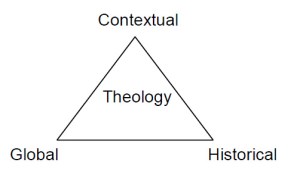
So, let me present a modest proposal for theological development in Argentina (and maybe for all of Latin America). I suggest a theology in three dimensions.

First, theology should be contextual, as Padilla wisely suggests. It must be local, connected to the issues and trends of its social context. It should be done by thinkers immersed in that setting, incorporating resources from that setting, and answering questions and addressing problems that arise out of that setting.

However, local Christian intellectuals must recognize a deficit that Padilla mentioned in his essay, “The Contextualization of the Gospel” (1979): “The church in Latin America is a church with no theological reflection of its own.” (He argued recently that the situation has improved, but that more development is needed. Watch the video.) The other challenge Padilla implied is that Latin America must not simply replace North American cultural evangelicalism with Latin American cultural evangelicalism. In the same essay he wrote:

No culture completely fulfills the purpose of God; in all cultures there are some elements unfavorable to the understanding of the gospel. For this reason, the gospel never becomes completely incarnate in any given culture. It always transcends cultures, even cultures that it has deeply affected.

Another weakness to avoid in contextualization is reductionism. Theology that focuses too deeply on one’s context and local thinkers, without maintaining the prophetic stance of the Bible that critiques all cultures, often supports the status quo in politics, culture, and worldview. Plus, too much contextual thinking and “thinking from below,” can produce deafness to the voices from the past and from around the globe. Theological reflection must incorporate contextual analysis but cannot be reduced to the context alone.

Second, theology should be global. French, German, Spanish, and English voices (and more) should be heard. People of color should be part of the discussion. Other local contexts have positive and profound contributions to make. Good theology is not only contextual but also listens to others around the world. In fact, perhaps at no time in history has the church had so many gifted leaders of every ethnic group and nation.

Third, theology should be historical. It must be deeply rooted in the scriptures and biblical-theological tradition. At no time in history has the church been blessed with so much excellent scholarship. We should learn from it, especially as a remedy for anti-intellectualism, ignorance, and irrelevance.

We should learn, for instance, from church history: our creeds, great thinkers, and accepted doctrines and practices. How did Abraham Kuyper and Dietrich Bonhoeffer confront the ideologies of their day? How did Pascal and C. S. Lewis communicate the Christian worldview? How did William Wilberforce, the Guinness family, and Martin Luther King alleviate critical social problems? What can we learn from our great thinkers of the past: Augustine, Anselm, Calvin, the Radical Reformers, Comenius, the English Puritans, Wesley, Edwards, and the Niebuhr brothers, for example? Learning from our wiser forefathers’ grounds our faith and prevents us from repeating foolish mistakes. History teaches us humility and wisdom.

So, this is my humble proposal: Latin American theology in Argentina should be three dimensional. It ought to listen to the context, voices from around the globe, and church history:
Now, if this proposal is acceptable, the next question is: What infrastructure is required to create a deeper and broader theology in Argentina and, indeed, in all Latin America?